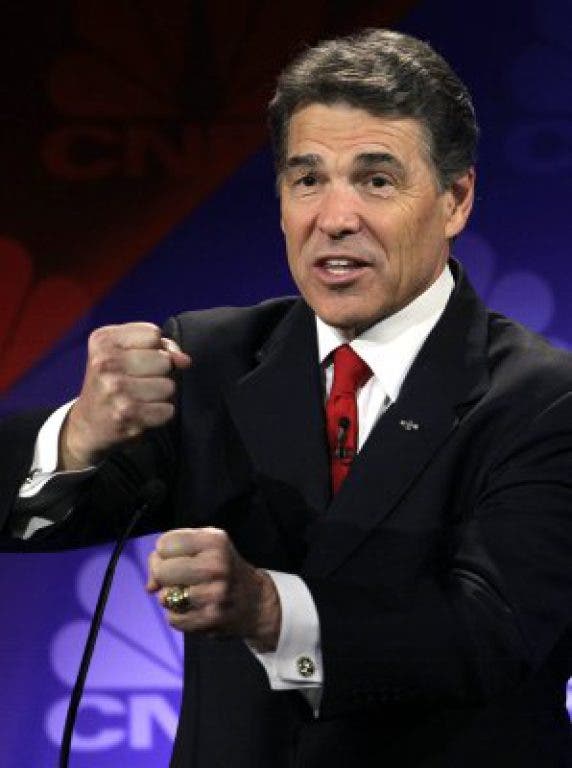
Texas Gov. Rick Perry told a Rancho San Diego megachurch Sunday that congregants have a “biblical directive” to be engaged in politics—but didn’t directly suggest how they should vote.
In April, conservative commentator at the same church and called on clergy nationwide to speak out politically from the pulpit even if it means risking their tax-exempt status under IRS law.
“We won’t have a nation if the pulpit doesn’t start preaching the truth,” Beck said.
But Perry, the former GOP presidential hopeful, didn’t recommend a candidate in his two sermons at Skyline Wesleyan Church.
He told the more than 2,000 attendees they have an obligation to be involved in the decision-making process.
“You have a biblical directive to be engaged in the public arena—to be involved in the decisions that are made that affect your life,” he said. “Somebody’s values are going to decide the environment you live in. Is it going to be a man or woman of faith?”
Perry, who read a verse from Samuel, told stories of his upbringing, times in governorship and when he “surrendered” his will to God. He also spoke about the business market and competition among states to attract major corporations.
“California is not so competitive,” he joked when he spoke about the number of companies that have chosen to open in other areas than the Golden State.
Perry also spoke about a time earlier in his governorship when Boeing had considered whether to open a local office in Dallas or Chicago. The company ultimately chose Chicago because of the “expansive” arts scene, according to Perry.
Perry said over the course of the decade, the state of Texas has opened more performing arts centers, theaters and museums to ensure the state is attractive to businesses.
He described the individuals who created a larger art scene in Texas as “those who understand biblical principles” and encouraged the congregation to elect those in office who understand that money given to the government must be spent on the community.
Click on the CoveritLive Widget to read the live blog.
From the White House Communications Office: Remarks by the First Lady at the African Methodist Episcopal Church Conference at Gaylord Opryland Resort, Nashville, Tenn., on Thursday, June 27, 2012: "And finally, I want to thank all of the bishops, pastors, and lay leaders in AME churches here in America and around the world. (Applause.) You all are part of a proud tradition, one that dates back to the founding of that first AME Church and the founding of this nation and has shaped its history every day since. You all know the story -- how back in the late 1700s, a man named Richard Allen bought his freedom from slavery -- (applause) -- became a minister, and eventually founded a Methodist church called Bethel Church - or "Mother Bethel" as we know it today. That first AME church was located in a blacksmith's shop, and that first congregation had just a few dozen members. But there's a reason why one pastor called Bethel's founding "a Liberty bell for black folks." (Applause.) There's a reason why W.E.B. Dubois said that Bethel Church "belongs to the history of the nation rather than to any one city."
.... "And that's what I want to talk with you about today. I want to talk about how we carry on the legacy that is our inheritance as Americans, as African Americans, and as members of the AME church. I want to talk about what we can learn from our history about the power of being an active, engaged citizen in our democracy.... Dr. King knew that. That's why back in 1965, he came to Brown Chapel AME Church in Selma and declared -- (applause) -- he said, "When we get the right to vote, we will send to the statehouse not just men who will stand in the doorways of our universities...but men who will uphold the cause of justice.... ...history has shown us that there is nothing -- nothing -- more powerful than ordinary citizens coming together for a just cause. (Applause.) And that is particularly true of folks in the AME church...."
What does that mean? That means being informed. It means following the news, and learning about who's representing us, and how our governments work. It means showing up to vote -- and not just every four years, but every year in every election. (Applause.) It means engaging with the folks we elect, following how they vote and how they spend our hard-earned tax dollars. And if you don't like what you see, then let them know, or better yet, run for a seat at the table yourself. (Applause.) And I know I am preaching to the choir here. I know that many of you have been active and engaged for decades. And I'm here today to urge you to continue that work and bring others along with you. Because we know that the only way to be heard above all the noise is to lift our voices up together...."
And to anyone who says that church is no place to talk about these issues, you tell them there is no place better -- no place better. (Applause.) Because ultimately, these are not just political issues -- they are moral issues. They're issues that have to do with human dignity and human potential, and the future we want for our kids and our grandkids. And the work of inspiring and empowering folks, the work of lifting up families and communities -- that has always been the work of the AME Church. (Applause.) That's what you all do best. Think about it for a minute. Folks just don't turn to all of you in times of spiritual crises. They come to you with financial crises and health crises and family crises of all kinds. That's why AME churches are taking on issues from HIV/AIDS to childhood obesity to financial literacy. Every day, you all are giving folks the tools they need to take control of their lives and get back on their feet...."
Because if a young shepherd could defeat a giant -- (applause) -- if a man could lead a band of former slaves against the most powerful city in the land until its walls tumbled down, if a simple fisherman could become the rock upon which Christ built his church -- (applause) -- then surely, we can do our part to be more active citizens.... And I want you to think of the stories in the Bible about folks like Abel and Noah; folks like Abraham and Sarah, and the verse in Hebrews that says, "All these people were still living by faith when they died. They did not receive the things promised. They only saw them and welcomed them from a distance." (Applause.) Through so many heartbreaks and trials, those who came before us kept the faith. They could only see that promised land from a distance, but they never let it out of their sight."
Thank you, and God bless. (Applause.)" http://blogs.knoxnews.com/humphrey/2012/06/text-of-michelle-obamas-nashvi.html#more
...after 2 services the priest was at my mother's door assuring her that it would never happen again...
"The general Principles, on which the Fathers Atchieved Independence, were the only Principles in which that beautiful Assembly of young Gentlemen could Unite, and these Principles only could be intended by them in their Address, or by me in my Answer. And what were these general Principles? I answer, the general Principles of Christianity, in which all those Sects were united: And the general Principles of English and American Liberty, in which all those young Men United, and which had United all Parties in America, in Majorities sufficient to assert and maintain her Independence." --John Adams
"I now offer you the outline of the plan they have suggested. Let an association be formed to be denominated "The Christian Constitutional Society," its object to be first: The support of the Christian religion. second: The support of the United States." --Alexander Hamilton "The fundamental source of all your errors, sophisms, and false reasonings, is a total ignorance of the natural rights of mankind….The sacred rights of mankind are not to be rummaged for, among old parchments, or musty records. They are written, as with a sun beam, in the whole volume of human nature, by the hand of the divinity itself; and can never be erased or obscured by mortal power." --Alexander Hamilton
— Thomas Jefferson
Whereas, the Senate of the United States, devoutly recognizing the Supreme Authority and just Government of Almighty God, in all the affairs of men and of nations, has, by a resolution, requested the President to designate and set apart a day for National prayer and humiliation. And whereas it is the duty of nations as well as of men, to own their dependence upon the overruling power of God, to confess their sins and transgressions, in humble sorrow, yet with assured hope that genuine repentance will lead to mercy and pardon; and to recognize the sublime truth, announced in the Holy Scriptures and proven by all history, that those nations only are blessed whose God is the Lord...."
It behooves us then, to humble ourselves before the offended Power, to confess our national sins, and to pray for clemency and forgiveness...."
All this being done, in sincerity and truth, let us then rest humbly in the hope authorized by the Divine teachings, that the united cry of the Nation will be heard on high, and answered with blessings, no less than the pardon of our national sins, and the restoration of our now divided and suffering Country, to its former happy condition of unity and peace...."
Done at the City of Washington, this thirtieth day of March, in the year of our Lord one thousand eight hundred and sixty-three, and of the Independence of the United States the eighty seventh." By the President: Abraham Lincoln William H. Seward, Secretary of State.
They were not the very first ten words in the Bill of Rights by accident. The Founders knew that ideologues would constantly attempt to inflict their religious intolerance on other citizens of different or no faith. People come to America to escape from the domination of majority religions holding civil power in their home countries, and the hate, discrimination, and corruption such a mix engenders. Many founders used references to Jesus or Christianity in their PRIVATE writings. While many were Deists, some were not, and even the Deists were careful in the language used in the Constitution. Read it some time, and see if you find the word "Christian" anywhere in it. The thought that an American would seek to impose his or her religious beliefs on other Americans by making those beliefs the law of the land is fundamentally misunderstand what it means to be an American. That's what they do in Iran, and Saudi Arabia, not in America.
Jefferson wrote An Act For Establishing Religious Freedom for the Virginia Assembly in 1779. http://faithandfreedom.us/documents/faith/18thcentury/jeffersonreligiousfreedom.htrr Regarding civil law and religion, Jefferson's views were the exact opposite of yours.
’Tis substantially true, that virtue or morality is a necessary spring of popular government. The rule indeed extends with more or less force to every species of free Government. Who that is a sincere friend to it, can look with indifference upon attempts to shake the foundation of the fabric..." --George Washington
In 1789, James Madison, then an elected member from Virginia of the First Congress's House of Representatives, proposed 19 amendments meant to answer the objections already raised in the states. The Senate consolidated and trimmed these down to 12, which were approved by Congress and sent out to the states by President Washington in October, 1789. The states ratified the last 10 of the 12 amendments. They became the first 10 amendments to the Constitution, and are now referred to as the Bill of Rights. Not enough states (10 were needed at the time) ratified the first two of Madison's original 12, however, and they did not become law." http://teachinghistory.org/history-content/ask-a-historian/21861
Jefferson wrote - A Bill Establishing Religious Freedom - Virginia 1779 http://faithandfreedom.us/documents/faith/18thcentury/jeffersonreligiousfreedom.htm
I've read those words many times, and while I fully understand the Founder's wish to avoid the implementation of an "established (i.e., "state") church" (al'a England's) I find no evidence that this is in any way synonymous with the abolition or prohibition of religion in public life. In fact, as their writings make abundantly clear, the intention of the Founders was precisely the opposite. The absence of a state church was meant to foster religious expression and freedom of worship in both the public and private realms.
The USA was not founded on Christian principles, and two separate analyses show this. One from a Biblical perspective, and another from the laws of the land including the DoI, the Constitution, and legislation.
Because all that line of reasoning does is invite the other side to cite some founders who make very Christian-y quotes, and all you are left with is dueling pianos. Here's how I explain the secular foundation, and it is based on what we have as laws. http://bit.ly/T45SUr
Regarding religious displays at holidays, etc., I am not overly concerned. I don't believe non-Christians are traumatized for life by seeing a manger scene at Christmas. At the same time, many "Christians" go absolutely nuts when they see a Muslim or Buddhist or some other religious symbol, or building, erected in what the "Christians" consider the "wrong place." We see that every day. It's called hypocrisy. No one is immune. P.S. McCain Vally and Mission Trails Park. Both need our help.